

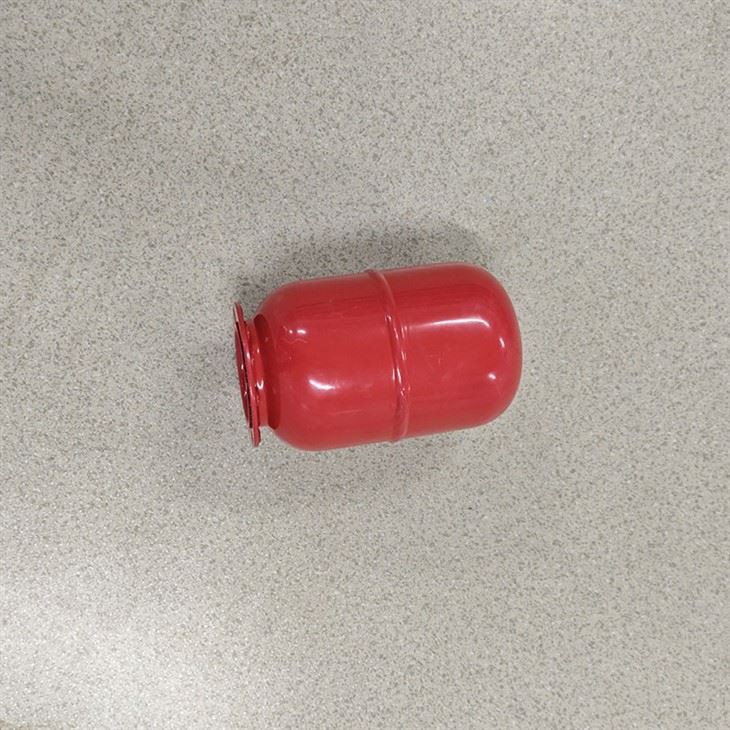


The primary challenge in forming a seamless cylinder is managing the "Plastic Deformation Zone." If the metal flows too quickly, you get wrinkling; too slowly, and the wall fractures.
The Problem: "Orange Peel" Surface Defects
Cause: Excessive grain growth due to improper blank-holding pressure.
Mould Solution: We integrate segmented blank holders that allow for localized pressure adjustment, ensuring the sheet metal is "stretched" rather than just "squeezed."
The Problem: Longitudinal Cracking
Cause: Residual internal stress and insufficient die radius.
Mould Solution: Our Fire Extinguisher Mould employs a multi-radius entry curve. This gradually transitions the metal from a flat sheet to a vertical wall, reducing the "Instantaneous Peak Stress" by up to 25%.
The Science of Interface Lubrication
A common mistake in factory operation is neglecting the "boundary lubrication" between the die and the workpiece.
Technical Insight:
At pressures exceeding 400 MPa, standard oils fail. Our tooling is designed to work with High-Pressure Polymer Lubricants or solid-film coatings like Tungsten Disulfide ($WS_2$). This reduces the heat generation at the draw-ring interface, preventing the "Scuffing" that often ruins the aesthetic finish of fire extinguisher canisters.
Failure Prevention Matrix: Die Wear Analysis
| Failure Mode | Visual Indicator | Corrective Mould Engineering |
| Galling | Vertical scratches on the cylinder. | Apply CVD (Chemical Vapor Deposition) coating. |
| Fatigue Striations | Hairline cracks on the punch radius. | Switch to S7 Shock-Resistant Steel. |
| Ejection Seizing | Part gets stuck in the cavity. | Implement pneumatic "Air-Lift" assist valves. |
| Ovality | Cylinder is not perfectly round. | Recalibrate guide-post centering to $<10 \mu m$. |
Advanced Tooling: The Integration of "Smart" Sensors
To move toward "Zero-Downtime" manufacturing, we offer an optional Sensorized Fire Extinguisher Mould package. By embedding piezoelectric strain gauges directly into the die block, operators can monitor:
Real-time Draw Force: Detect if a batch of raw steel is harder than specified.
Tool Temperature: Automatically trigger a cooling cycle if the die exceeds $180^\circ C$.
Vibration Analysis: Identify early signs of bearing or guide-post wear before they cause a breakdown.
Final Commissioning: The "Golden Sample" Protocol
Every Fire Extinguisher Mould we produce must pass the "Golden Sample" test. We run the tool at 110% of its rated speed for 4 hours. The resulting 100 samples are then subjected to a Destructive Burst Test and a Ultrasonic Wall-Thickness Map. Only when these samples prove 99.9% consistency do we approve the tool for international shipment.
Hot Tags: engineering solutions: troubleshooting deep-drawing defects in fire extinguisher mould production, China engineering solutions: troubleshooting deep-drawing defects in fire extinguisher mould production manufacturers, suppliers, factory


