

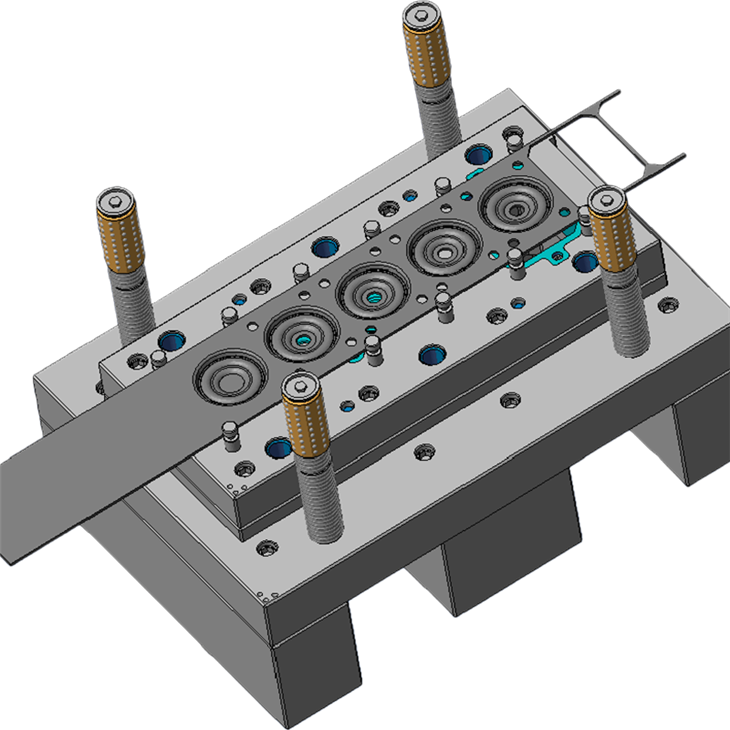
Methodology: The 3-Tier Validation Process
Step 1: Predictive Elasticity Analysis
Most stamping mold failures occur because the tool doesn't account for the "springback" of high-tensile materials.
Action: We apply iterative compensation algorithms to the die geometry.
Result: A tool that produces a perfect part on the first trial, reducing the need for costly manual "tuning."
Step 2: Kinematic Interference Checking
We perform a dynamic 3D simulation of the entire press stroke to identify potential collisions between the stripper, the scrap cutters, and the guide posts.
Detection: Identification of sub-millimeter interferences at maximum operating speed.
Benefit: Prevents catastrophic tool crashes during high-speed production runs.
Step 3: Pilot Run Documentation (T-Zero Testing)
Before final approval, every stamping mold undergoes a "Stress Soak."
Metric: Continuous operation at 110% of the target SPM (strokes per minute).
Outcome: A comprehensive "Health Report" including strip tracking accuracy and temperature stability of the forming inserts.
Technical Specifications Matrix
| Feature | Technical Implementation | Purpose |
| In-Die Tapping | Integrated mechanical or servo units | Eliminates secondary operations; lowers per-part cost. |
| Nitrogen Manifolds | Pre-balanced gas spring systems | Ensures uniform pressure distribution across large plates. |
| Quick-Change Inserts | Dovetail or Ball-Lock retention | Reduces maintenance downtime from hours to minutes. |
Hot Tags: high-stability press tooling: precision stamping molds engineered for zero-failure integration, China high-stability press tooling: precision stamping molds engineered for zero-failure integration manufacturers, suppliers, factory


